Iran’s long reach: Saudi's east–west pipeline under fire
A suspected Iraq-based attack on Saudi Arabia’s East–West Pipeline shows the growing reach of Iran and its aligned groups, from Yemen to Iraq, as conflict engulfs the region. The strike shuts down a critical bypass for Hormuz and brings the fighting another step closer to producing assets.
Iran’s Long Reach: The East–West Pipeline Under Fire
Twenty-five years after the World Trade Center towers fell and the United States declared a war on terror, America once again finds itself deeply entangled in the Middle East. The attack on Saudi Arabia’s East–West Pipeline marks another escalation in a conflict the global oil market cannot absorb indefinitely.
I was recently reminded of a warning made in 2019 by Abolfazl Shekarchi, the senior spokesperson for Iran’s Armed Forces: “If the enemy, especially America and its allies in the region, make the military mistake of shooting the powder keg on which America’s interests lie, the region will be set on fire.”
Industry sources confirmed to Kpler that the September 10 attack struck the East–West Pipeline at multiple locations, causing significant damage to at least one pumping station. The Saudi Energy Ministry subsequently confirmed that the pipeline—Saudi Arabia’s principal escape route from a constrained Strait of Hormuz—had been shut down as a precaution.
Saudi Aramco has repaired this system quickly before, with attacks earlier this year resulting in relatively short-lived disruptions. Initial indications suggest the latest damage may be more serious. How much capacity can be restored—and how quickly—remains unclear.
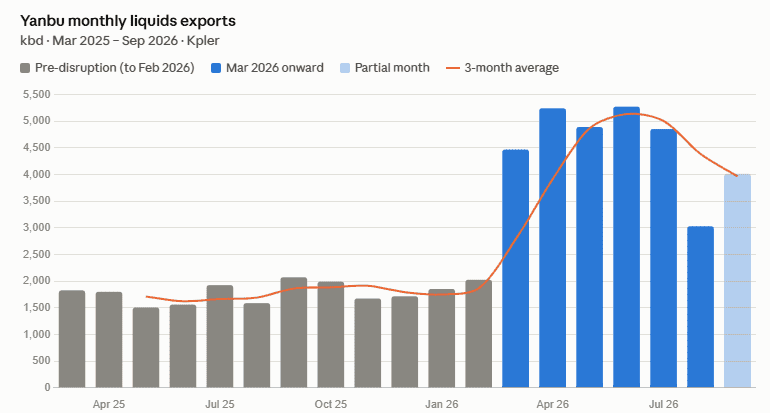
The East–West Pipeline carries crude roughly 1,200 kilometers from Saudi Arabia’s eastern producing regions across the desert to Yanbu on the Red Sea. With nameplate capacity of around 7 million bpd, it has effectively become a lifeline for Saudi crude exports during the conflict—the infrastructure designed to keep Saudi barrels moving when the Strait of Hormuz cannot.
Pumping stations along Petroline maintain the pressure required to move millions of barrels per day across changes in distance and elevation. Damage to a critical station can therefore have consequences far beyond the physical section that was struck. Depending on which station was damaged and the ability to modify operations around it, throughput could fall sharply even if much of the pipeline itself remains intact.
Since the conflict began, Aramco has predominantly filled the system with lighter crude grades, helping maximize achievable flow rates and preserve export capacity. A prolonged outage would remove that flexibility, leaving Saudi Arabia with few alternatives. Kpler estimates that without the East–West Pipeline, Saudi crude exports could ultimately fall by roughly 3.5–4 million bpd, depending on the severity and duration of the disruption.
Throughout the conflict, Saudi Aramco has continued to meet customer commitments without declaring force majeure, drawing on storage facilities around the world when necessary. Maintaining its reputation as one of the world’s most dependable suppliers remains a priority, and Aramco plans to continue using its global inventory network while Petroline is repaired.

See why the most successful traders and shipping experts use Kpler