Empowering researchers and journalists with actionable insights.


.webp)



350k+
40+
1.3bn
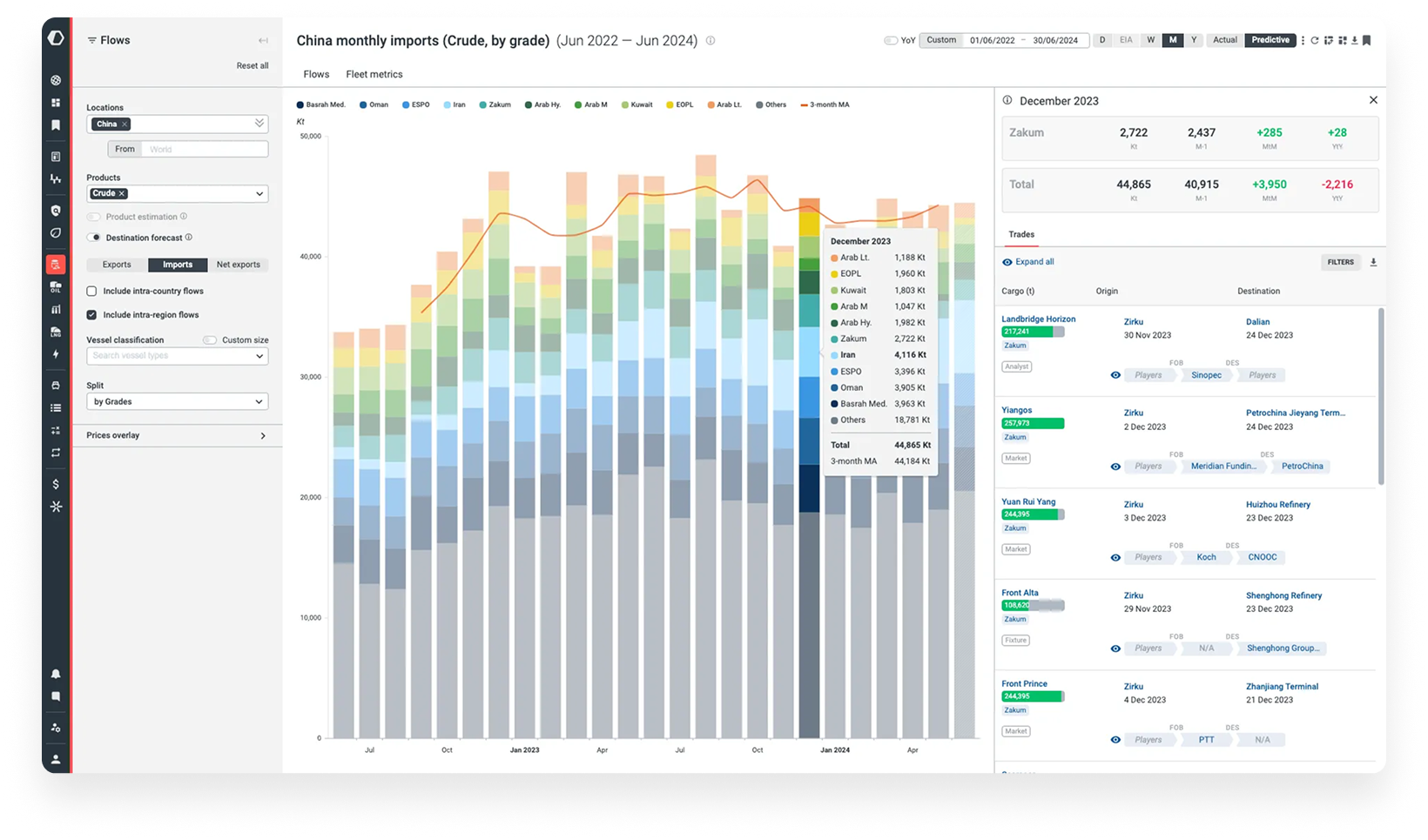
Analyze Market Trends: Dive into historical and real-time data to identify emerging patterns across energy, metals, and agricultural markets. Leverage detailed trade intelligence for scholarly publications or policy recommendations.
Model Economic Impacts: Use granular trade data and vessel tracking information to simulate global supply chain scenarios, enabling robust economic impact analyses.
Validate Hypotheses with High-Quality Data: Access reliable datasets to support research hypotheses and ensure accuracy in academic papers or reports.
.webp)
Break Stories with Real-Time Data:Access the latest insights into global trade movements, supply chain disruptions, and price trends to craft timely, impactful stories.
Verify and Fact-Check Sources:Utilize reliable vessel and commodity data to validate claims and ensure accurate reporting.
Illustrate Market Trends with Data Visualization:Leverage clear, compelling charts and graphics to communicate complex market dynamics to diverse audiences effectively.
.webp)

.webp)
FAQ
Kpler provides verified, high-quality historical and real-time data across energy, metals, agriculture, and shipping—enabling researchers to validate hypotheses with accuracy and journalists to fact-check claims before publication. Rather than relying on secondary sources or estimates, you access primary data on global trade movements, vessel tracking, commodity flows, and supply chain activity. This data integrity is critical for academic credibility and journalistic accuracy, ensuring your publications, papers, and reports are grounded in reliable information that withstands scrutiny and supports compelling storytelling.
Yes. Kpler's granular trade data and vessel tracking information enable researchers to simulate complex global supply chain scenarios and model economic impacts with precision. You can analyze how geopolitical disruptions affect commodity flows, how supply shocks propagate through markets, or how infrastructure changes impact trade patterns. This capability transforms Kpler from a data source into a research platform—allowing you to test hypotheses about economic relationships, validate policy recommendations, and provide evidence-backed analysis that informs academic discourse and policy discussions.
Kpler delivers real-time insights into global trade movements, supply chain disruptions, price trends, and geopolitical impacts—enabling journalists to identify newsworthy developments as they unfold. Rather than waiting for official announcements or delayed reports, you can observe actual trade flows, vessel movements, and market shifts in real time. Combined with data visualization tools, you can illustrate complex market dynamics clearly to diverse audiences—explaining why oil prices are rising, how a port closure affects global shipping, or how geopolitical tensions disrupt supply chains with concrete, visual evidence.
Kpler offers intuitive mapping, charting, and analytics tools that transform complex trade and vessel data into clear, compelling visualizations—essential for communicating with academic peers, news audiences, policymakers, and executives. You can visualize trade flows on interactive maps, chart supply-demand trends over time, highlight geopolitical risks geographically, and present economic scenarios in formats that resonate with different audiences. Whether you're publishing a research paper, creating a news story, or briefing policymakers, Kpler's visualization capabilities help you tell data-driven stories that engage and inform.
Kpler combines historical trade patterns, real-time market data, and advanced predictive analytics to help analysts anticipate market changes, identify emerging risks, and forecast supply-demand dynamics. This forward-looking intelligence enables decision-makers—whether corporate strategists or policymakers—to make informed decisions ahead of market consensus. By understanding what's happening now and what's likely to unfold, analysts can provide decision-makers with accurate, actionable intelligence that shapes policy and corporate strategy based on data-driven foresight rather than reactive responses to market developments that have already occurred.